The Election That Broke the Pattern
Germany’s February 23, 2025 federal election delivered results that force us to reconsider narratives about European stability that had calcified over the past sixteen years. Friedrich Merz’s CDU/CSU won approximately 28.5 percent of the vote, making it the largest parliamentary bloc and ending the Scholz era with considerable finality. Yet this headline figure obscures more than it illuminates. The real story is the comprehensive realignment of German electoral politics that unfolded around them. The SPD collapsed to its worst federal result since 1945, receiving around 16.4 percent. Meanwhile, the Alternative for Germany finished second with roughly 20.8 percent, its strongest-ever federal performance. These figures describe not merely a change of government but a fundamental restructuring of the competitive landscape itself.
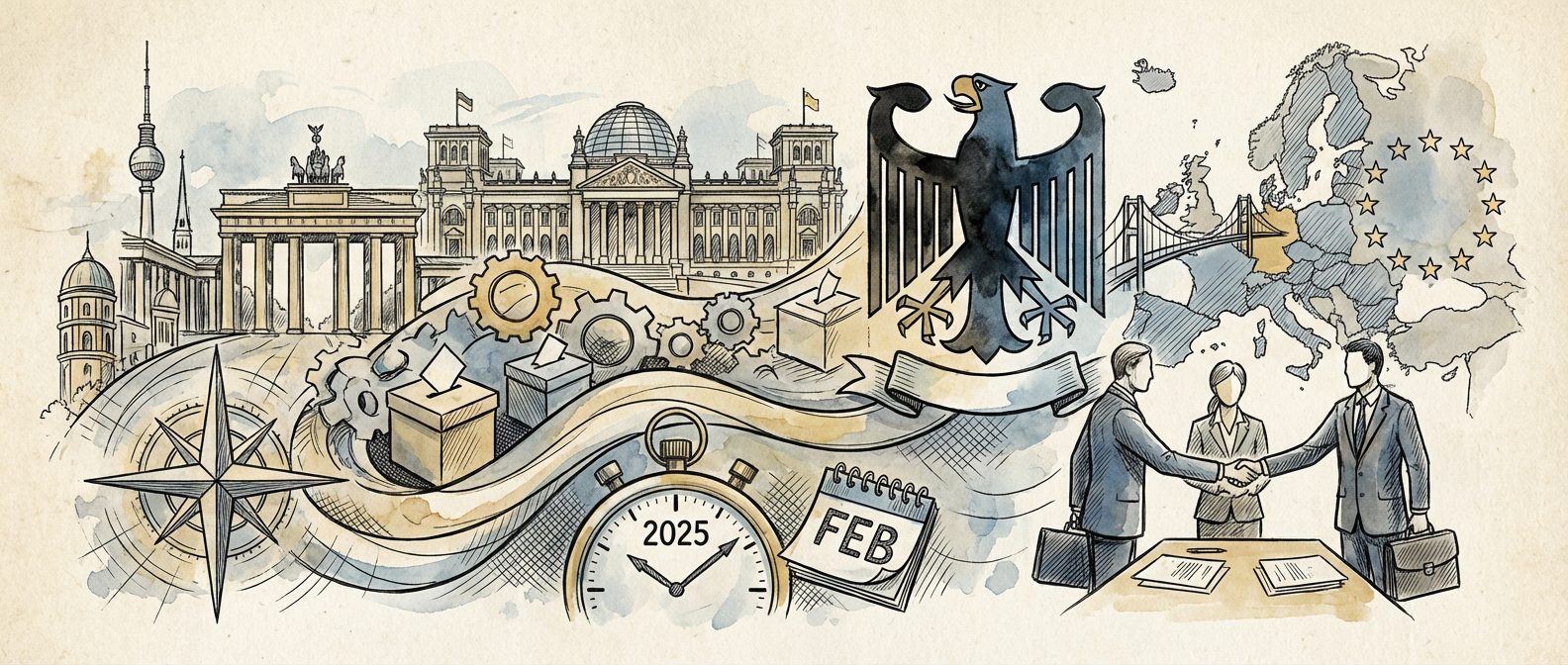
To understand what occurred, we must first acknowledge what did not occur. This was not a landslide victory in any conventional sense. The CDU/CSU’s 28.5 percent is the weakest result for a winning bloc in German federal politics since the 1960s. Yet calling this outcome weak misses the analytical point entirely. The weakness of the winning coalition reflects not the strength of a dominant opposition but rather the fragmentation of the German electorate into increasingly incompatible voting blocs. Coalition formation has grown more difficult even as one party has grown more clearly dominant. This paradox, which would have seemed impossible to political scientists trained in post-war German history, now defines the terrain on which Merz must govern.

The Historical Echo and Why It Matters
Anyone studying German electoral history encounters a curious pattern: whenever grand coalitions between the CDU/CSU and SPD have formed during periods of genuine crisis, they have typically preceded significant constitutional or institutional reform. The Grand Coalition of 1966 to 1969 preceded the socio-economic transformations of the 1970s. The CDU/SPD partnership under Merkel from 2013 to 2017 managed the refugee crisis and laid groundwork for energy transition policies. Now Merz inherits a situation that bears structural resemblance to those moments, though the content differs dramatically. German public trust in federal institutions had fallen to 38 percent according to the Bertelsmann Foundation’s 2025 Democracy Index, its lowest recorded level. When institutional confidence drops this far, grand coalitions often become vehicles not merely for power-sharing but for substantive constitutional and structural reform.
The historical parallel requires careful calibration, though. We should not simply project past experiences onto current circumstances. The 1960s faced different challenges than today’s climate transition and industrial competitiveness questions. Yet the structural similarity warrants attention: when German elites perceive that incremental adjustments within existing constitutional and institutional frameworks prove insufficient to address systemic challenges, they have historically turned to grand coalitions as instruments for deeper change. The inclusion of a 500 billion euro special infrastructure fund requiring constitutional amendment in the governing agreement between Merz and the SPD suggests that contemporary policymakers recognize this historical pattern themselves. Whether this represents learned wisdom or mere imitation of form remains to be seen.
Coalition Mathematics and the Frozen Landscape
Merz’s path to government required far more patience and negotiation than simple plurality arithmetic might suggest. The AfD’s second-place finish fundamentally altered coalition geometry in ways worth examining closely. For decades, German political culture maintained what observers called the “cordon sanitaire,” an agreement among mainstream parties that AfD inclusion in any governmental arrangement remained unacceptable. This principle held through the AfD’s entry into the Bundestag in 2013, through its emergence as a significant parliamentary force in 2017, and through its consolidation of support in eastern states throughout the 2020s. The 20.8 percent result did not break this consensus so much as test its resilience to the breaking point.
Merz pursued a grand coalition with the SPD rather than exploring other arithmetic combinations, despite the political costs such an alliance entails for his own party base. This choice deserves interpretation. A three-party coalition including the Greens would have offered more ideological coherence internally, yet would have required navigating competing environmental and economic policies simultaneously. A smaller coalition with the Greens or Free Democrats would have provided Merz greater governing flexibility, yet would have exposed Christian Democratic policy commitments to constant veto threats from junior partners. The grand coalition, by contrast, offered something less frequently discussed: a governing arrangement sufficiently large and sufficiently rooted in post-war consensus to weather the institutional trust crisis that preceded the election. This choice reflected not weakness but a judgment about what contemporary German governance actually requires.
European Implications of German Leadership Transition
Merz’s assumption of the chancellorship carries consequences that extend far beyond Berlin. Germany’s relationship to European integration, NATO commitment, and economic policy direction had calcified during Merkel’s era and shown increasing brittleness under Scholz. The CDU/CSU has historically maintained a more explicit commitment to European federalism than the SPD, even as both parties support EU membership. More immediately, Merz brings a different temperament to questions of transatlantic relations. Where Scholz often appeared cautious and reactive regarding European defense spending and industrial policy coordination, Merz has consistently advocated for accelerated defense investment and more aggressive European technological competition with Asian and American firms. These rhetorical differences may translate into substantive policy shifts, though grand coalitions typically moderate such transitions through compromise.
The broader European question concerns what German political realignment means for continental leadership at a moment when the union faces simultaneous challenges from eastern security threats, American policy uncertainty, and internal cohesion questions. For nearly two decades, Germany provided a kind of centripetal force within European politics, cautious, consensus-oriented, often frustratingly incremental in its approach to shared challenges. The 2025 election and the coalition that followed do not necessarily signal a dramatic rupture with this role, yet they do suggest that German policymakers recognize such caution may no longer serve European interests adequately. Whether Merz’s coalition can translate recognition into effective action remains the consequential open question.
Institutional Trust and the Legitimacy Challenge Ahead
The Bertelsmann Foundation’s measurement of institutional trust represents more than a statistical finding. At 38 percent, this figure describes a political system in which fewer than two in five citizens express confidence in federal government institutions. Merz takes office amid this confidence crisis, not despite it, and that should shape how we interpret what his governance must accomplish. Traditional German grand coalitions benefited from relatively robust underlying institutional legitimacy. The current arrangement must simultaneously govern and attempt to restore the public confidence that appears to have eroded beneath partisan conflict and long-term economic uncertainty.
This dual challenge may explain Merz’s willingness to include constitutional amendment in his governing agreement with the SPD. Such amendments require supermajority support and function as signals of cross-party seriousness. In a political context where public cynicism about elite competence has risen substantially, visible commitment to constitutional processes and explicit cross-party negotiation can serve legitimating functions that purely partisan governance cannot. Whether this strategy proves sufficient to rebuild institutional trust or merely manages its continued decline will shape German politics and the European trajectory for years to come. The question ultimately concerns whether democracies can restore confidence through institutional reform once that confidence has eroded to these depths. Germany’s experience over the coming years will provide evidence that extends well beyond its borders.
The February 2025 election and the coalition that followed mark a genuine transition point in German and European politics. Yet the meaning of that transition remains contested and open. Bundestag Official 2025 Election Results provide the raw data, while Bertelsmann Stiftung Democracy Report contextualizes the institutional environment within which Merz must operate. How observers interpret these developments often depends on what we believe about the capacity of political institutions to adapt and restore legitimacy during periods of significant stress. What do you make of Germany’s path forward at this particular historical juncture?