The Election Results and What They Actually Tell Us About German Politics
When Friedrich Merz’s Christian Democratic Union and Christian Social Union won the February 2025 federal election with approximately 28.5 percent of the vote, political observers across Europe noted that this was the party’s strongest performance in over a decade. Yet this framing, while technically accurate, obscures more than it illuminates. The CDU/CSU secured their best result since 2009, but that historical comparison reveals something uncomfortable about German electoral politics: in the early 2000s, when the party consistently polled above 35 percent, that was considered merely competent performance, not triumph. The 2025 result, strong as it is, reflects a fragmented political landscape where no single party commands the broad consensus that earlier post-war governments took for granted.

The real shock in February’s election came not from the CDU/CSU’s success but from the simultaneous rise of the Alternative for Germany, which secured roughly 20.8 percent of the vote. A historic high for a far-right party in post-war German federal elections. For those accustomed to thinking about European politics through conventional left-right frameworks, this created a fundamental complication: the two strongest vote-getters were separated by an ideological gulf so wide that formal coalition talks between them were essentially impossible from the outset. This was not mere political theater. The CDU/CSU’s founding principles rest explicitly on rejecting extremism, and the mainstream parties had spent years developing formal mechanisms to exclude the AfD from governance. Understanding Merz’s pathway to power therefore requires grasping why his coalition partners looked not to the right but to the center-left.
The Coalition Arithmetic and Why It Matters More Than It Appears
Merz’s government was formally confirmed in April 2025 through a coalition with the Social Democratic Party, producing a governing majority of 328 seats in the 630-seat Bundestag. On its surface, this seems like conventional European coalition mathematics: center-right and center-left parties sharing power. But the specific composition of this majority carries implications that extend well beyond Berlin. The SPD finished a distant third in February’s voting, yet they possessed something the CDU/CSU desperately needed: legitimacy. Any government that excluded them would have rested on a narrower base, appearing unstable and ideologically incoherent. The decision to govern with the SPD signaled that Germany’s political establishment remained committed to broad-based, consensus-oriented governance despite the electoral fragmentation visible in the results.
This coalition structure created internal tensions from day one. The SPD entered government as junior partners, despite the constitutional propriety of shared executive power. Merz’s team held more ministries, controlled the chancellery’s direction-setting apparatus, and possessed the stronger electoral mandate. Meanwhile, AfD voters could point to the coalition as evidence that the traditional parties were conspiring to exclude them from influence. This is a genuine problem in democratic theory, not merely partisan grievance. When roughly one voter in five supports a party that governing coalitions deliberately exclude, questions about representation and democratic legitimacy become serious matters. Understanding Merz’s first hundred days therefore requires recognizing that he was governing not just a coalition, but a legitimacy crisis layered beneath the surface of conventional parliamentary mechanics.
The Fiscal Revolution and Germany’s Constitutional Reckoning
Perhaps the most striking act of Merz’s nascent government came in March 2025, when the Bundestag passed a €500 billion infrastructure and defense spending package that required suspending Germany’s constitutional debt brake. This action demands careful parsing, because its significance operates on multiple levels. Germany’s debt brake, enshrined in the constitution in 2009, represented a specific ideological commitment: the belief that governments, like households, should avoid persistent deficits and that constitutional constraints could impose fiscal discipline. For over fifteen years, this rule shaped German economic policy and German political identity. German officials regularly lectured other European nations about fiscal responsibility, often with an undertone suggesting that profligacy reflected moral failing rather than mere economic disagreement. Suspending this rule required not just legislative votes, but a fundamental recalibration of how Germany’s political leadership understood their fiscal obligations.
The specific uses of this spending reveal the logic driving the decision. The package was explicitly framed as addressing both infrastructure investment and defense modernization. Here lies a crucial recognition that Merz’s government was making visible: Germany could no longer assume that security would be provided by others, and infrastructure investment had been deferred so long that leaving it further postponed risked economic competitiveness. The Ukraine war’s continuation, Russian military modernization, and American signals about the limits of permanent security commitments all converged on a single conclusion in Berlin. You can examine Merz government’s €500 billion spending package — Deutsche Welle for detailed reporting on how this spending was allocated and justified. What matters here is recognizing that this was not technocratic budget adjustment but a strategic pivot in how Germany understood its role in Europe and its responsibilities to European security architecture.
The Military Rearmament and NATO Realignment
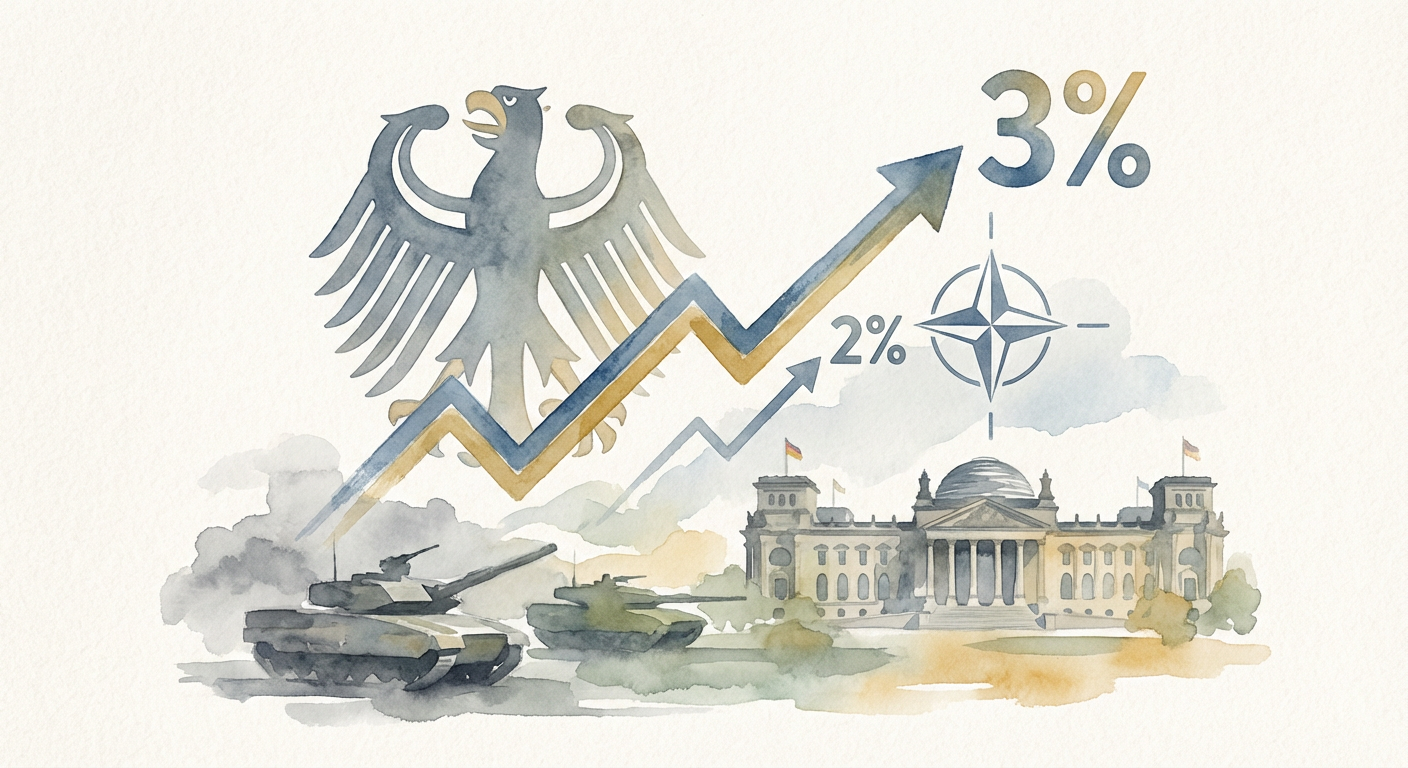
Connected directly to the €500 billion spending initiative was the decision to place the Bundeswehr’s budget on a trajectory toward 3 percent of GDP by 2027, exceeding NATO’s established 2 percent benchmark. This requires understanding why this specific percentage matters. NATO’s 2 percent guideline emerged from burden-sharing negotiations among alliance members, with the United States arguing for years that European countries were underfunding defense while relying on American security guarantees. For Germany specifically, this carried historical resonance. The post-war settlement had created a military subordinate to civilian control and focused on territorial defense within NATO frameworks, not independent power projection. German defense spending as a percentage of GDP had languished well below 2 percent for decades, reflecting both fiscal constraint and a deliberate political choice rooted in historical memory.
Merz’s commitment to exceed 3 percent by 2027 was a statement that Germany was prepared to assume a different role in European security architecture. Not merely budgetary. Conceptual. A more heavily armed Germany, even under civilian control and NATO oversight, carries different implications for European geopolitics than the post-Cold War configuration to which Europeans had grown accustomed. The decision implied that Germany would not wait indefinitely for security threats to arrive, and that forward defense might require capabilities Germany had historically chosen to forgo. You can consult Germany’s 2025 election results — Federal Returning Officer for complete electoral data, but the policy questions emerging from those results proved far more consequential than the voting percentages themselves.
What This Means for European Politics Beyond Germany
The first hundred days of Merz’s government signal something broader about European center-right governance in the 2020s: external pressure, fiscal constraint, and internal political fragmentation are forcing a recalibration of assumptions that have governed European politics since 1945. Germany’s debt brake suspension, its military spending trajectory, and its coalition choice all reflect responses to conditions that transcend Germany’s borders. The continuation of war in Ukraine, the uncertainty of American strategic commitment under changing administrations, and the rise of far-right political movements across Europe create a context in which previous policy inheritances no longer suffice.
For observers interested in how democratic societies navigate genuine dilemmas without easy solutions, the Merz government offers a case study worth sustained attention. The questions facing Germany—how to respond to security threats without repeating historical mistakes, how to maintain fiscal credibility while making necessary investments, how to govern democratically when significant voter blocs are excluded from coalitional arithmetic—are not uniquely German. They represent challenges that democracies across Europe and beyond will confront as external pressures mount and internal consensus fragments. The governance choices Merz makes in his administration’s first year will likely echo through European politics for a decade.
What aspects of German coalition politics or European security strategy interest you most? The mechanisms through which democracies manage external pressure while maintaining internal legitimacy remain underexamined in public discourse, and Germany’s current moment offers particular clarity on these dynamics.