Let me start with why this development matters to people who follow politics. This sits at an intersection that politics audiences are better equipped to understand than most.
Beyond the Current Moment: A Revolution in the Making
Here’s what most people miss. The current situation is interesting, but what’s building for the near future is far more significant. While everyone watches ChatGPT and corporate AI assistants, a completely different revolution is happening in the open-source community. At the center is SillyTavern, an application that doesn’t look like much but has become the foundation for AI-powered creative roleplay.
I’ve been tracking the numbers, and they tell part of the story. Only part, though.
This goes well beyond chatbots or entertainment. The tools and methods being developed in AI roleplay are changing how humans interact with artificial intelligence. They’re creating new forms of storytelling, therapeutic applications, and educational experiences that make the line between reality and imagination harder to draw.
The Technical Foundation of Creative Freedom
SillyTavern is an open-source frontend that connects users to both local and API-based language models designed for character roleplay. The SillyTavern GitHub repository has over 15,000 stars, which reflects a massive global community of contributors who keep improving the platform.
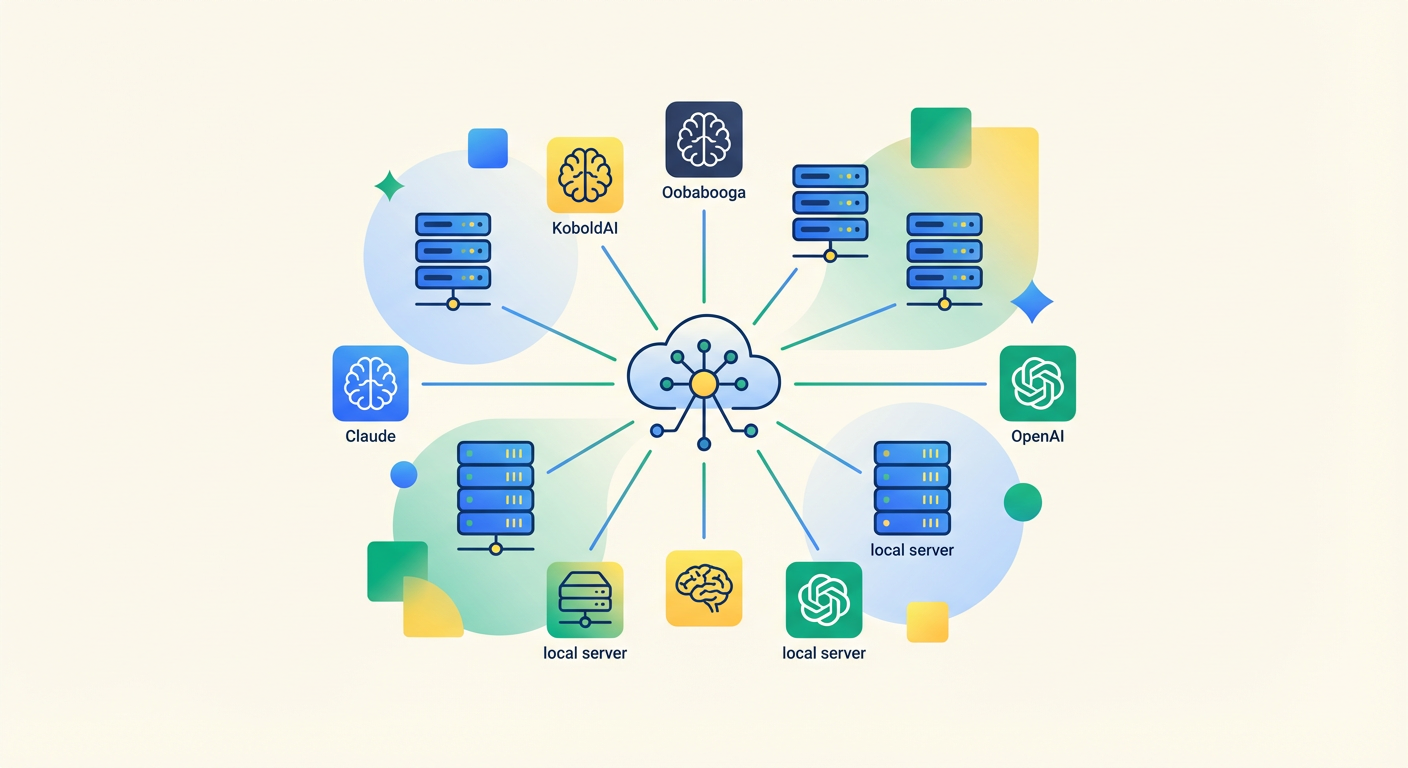
What makes SillyTavern different is its flexibility. The platform works with an extensive range of backends including KoboldAI, Oobabooga, Claude, OpenAI, and dozens of local model servers. This backend-agnostic approach means users can switch between different AI models depending on their needs, budget, or privacy requirements.
The real breakthrough comes through character cards and persona files. These configuration files let users create highly customized AI roleplay personas without writing any code. A character card might define personality traits, background story, speech patterns, and behavioral quirks that transform a generic language model into a specific character with depth and consistency.
Community-Driven Character Creation
The SillyTavern ecosystem runs on community collaboration. Thousands of pre-built character cards cover every possible genre, from historical figures and fictional characters to completely original creations. This massive library represents countless hours of creative work, freely shared among users who get that collective creativity helps everyone.
Character creation has become an art form within the community. Skilled creators write detailed backstories, define complex personality matrices, and fine-tune dialogue patterns to create convincingly authentic characters. These aren’t simple chatbots but sophisticated digital personas that can maintain consistent character traits across long conversations.
The collaborative nature goes beyond character sharing. Community members regularly contribute code improvements, bug fixes, and new features. This distributed development model has let SillyTavern evolve quickly while staying stable and user-friendly.
The Technical Challenge of Self-Hosting
Here’s the catch. Self-hosting a complete SillyTavern setup is technically demanding. Users must configure multiple software components and model servers, each with its own requirements and dependencies. The process involves installing SillyTavern itself, setting up a compatible language model backend, and making sure all components communicate properly.
Local hosting requires serious computational resources, especially for larger language models. Graphics cards with enough VRAM become essential for running models locally, while CPU-based inference is usually too slow for interactive roleplay. These hardware requirements create barriers for casual users who don’t have powerful gaming rigs or workstation computers.
For users who want the SillyTavern experience without the technical complexity, hosted solutions like Hearthside Chat — hosted SillyTavern provide professionally managed environments. These services handle the infrastructure complexity while preserving the creative freedom that makes SillyTavern compelling.
Implications Beyond Entertainment
SillyTavern started in roleplay and entertainment, but its applications go much further. Educators use character-based AI to create historical simulations where students interact with figures from different eras. Therapists are exploring AI-assisted roleplay as a tool for social skills development and emotional processing.
The platform’s flexibility makes it valuable for language learning, where students practice conversations with AI characters who speak consistently in target languages. Writers use SillyTavern to develop characters for novels and screenplays, engaging in dialogue to understand how their creations might speak and behave.
Most importantly, SillyTavern represents a democratization of AI interaction design. Rather than accepting whatever personality corporate AI providers decide to implement, users gain control over how AI behaves in their specific contexts. This shift toward user-controlled AI personality may prove important as artificial intelligence becomes more common in daily life.
The Future of Human-AI Interaction
SillyTavern’s success suggests that the future of AI interaction lies not in one-size-fits-all assistants but in highly customizable, context-specific AI personalities. As language models become more capable and accessible, the ability to craft specific AI behaviors for particular use cases becomes more valuable.
The open-source nature keeps these capabilities accessible to individuals and small organizations rather than being locked behind corporate paywalls. This accessibility could prove important in determining whether AI development serves broad human interests or primarily corporate objectives.
We’re seeing the early stages of a fundamental shift in how humans relate to artificial intelligence. Rather than treating AI as a tool or service, SillyTavern enables relationships with AI entities that have consistent personalities, memories, and behavioral patterns. These aren’t quite human relationships, but they’re not simply tool usage either. They represent something entirely new in human experience, and SillyTavern is helping define what that new category of interaction might become.
If you’ve been curious about SillyTavern but find the self-hosting setup daunting, the platform offers a fully managed version that handles the technical side so you can focus on the creative work.
Understanding the mechanism matters as much as knowing the outcome. Follow the full thread for sourced breakdowns.